Good wine shop merchandising should do more than make the place look nice. It should make people stop at the window, pick things up, ask questions and, ideally, discover a bottle they weren’t planning to buy.
So this is a collection of wine shop merchandising ideas with a bit more imagination. Some are incredibly simple. Others might require a trip to a reclamation yard, a bit of DIY or the willingness to suspend something unusual from the ceiling.
There are ideas for windows, shelves, counters and the pavement outside, from wine bottle mirrors and cork walls to old basket presses, vineyard rocks and Christmas trees made from empty bottles.
Most importantly, we’ve tried to concentrate on ideas that actually do something. A lump of limestone can help explain terroir. An old barrel can start a conversation about oak. A mirror can get someone to stop outside. A basket press can become the centrepiece of a harvest event.
Steal whatever works for your shop. And keep coming back. We’ll continue adding good ideas as we find them.
Contents
Ideas for your window
Make something giant
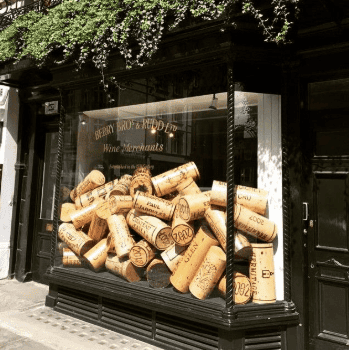
Giant bottles, corks, glasses, you name it. Taking an everyday wine object and making it enormous is a simple way to bring wine, and the context it’s enjoyed in, to life. It also makes an eye-catching statement on the high street.
Why do it? Changing the scale of something familiar makes people notice it. An enormous bottle or wine glass can transform an otherwise ordinary window display into something playful, photographable and visible from the other side of the street. Credit to Berry Bros. & Rudd for the giant cork idea.
How to do it: You don’t necessarily need to commission an expensive prop. Look at theatrical props, old advertising displays and second-hand shop fittings, or make your own from plywood, cardboard, papier-mâché or polystyrene.
Top tip: Use fabric to recreate wine pouring from a giant bottle or into a glass. Draped and twisted in the right way, it can create a surprisingly convincing sense of flowing liquid without the mess. Paint-shop window displays often use the same trick to represent pouring paint, so they’re a good place to look for inspiration.


⸻
Wine o’clock

It’s Wine O’Clock! Get yourself some cheap wall clocks on Amazon and recreate this visual pun.
⸻
Make the corks flow
Here’s a clever way to make a window display look as though it’s defying gravity. Suspend an empty wine bottle above the display, then create a curved stream of corks apparently pouring from its neck into a glass below.
Why do it? It’s simple, unmistakably wine-related and has that little “hang on, how have they done that?” quality that makes people stop and look.
How to do it: Create the hidden structure with a length of stiff wire or thin metal rod running from the glass to the bottle, then glue or carefully drill and thread corks along it to disguise the support. Fix the empty bottle securely at the top and fill the receiving glass with loose corks to hide the base. The more completely the corks conceal the supporting rod, the better the illusion.

⸻
Draw the wine onto the window
Sometimes the simplest window displays are the most effective. Line up a few bottles behind the glass, then use a white window marker to draw oversized bottle outlines around them. Suddenly, a fairly ordinary row of wines becomes a proper display.
Why do it? The drawings make the bottles feel playful and larger than life, while giving people walking past another reason to notice the wines. Better still, the idea is endlessly refreshable. Change the bottles and redraw the window whenever you have a new arrival, seasonal selection or particular wine you want to push.
How to do it: Put your chosen bottles close to the window and use a removable chalk or window marker to sketch around them. You don’t need to be an artist. In fact, the slightly hand-drawn look is part of the charm. Add tasting notes, arrows, prices or little illustrations if you fancy, then wipe it clean and start again when it’s time for something new.

⸻
Hang wine glasses in the window
Instead of putting bottles in your window, why not fill it with wine glasses? Suspending glasses at different heights creates a striking display that catches the light and gives the impression of glasses of wine floating in mid-air.
Why do it? It takes an object everyone associates with wine and uses it in an unexpected way. The repetition looks impressive from the street, while the different heights create movement and make good use of the full height of the window rather than just the sill.
How to do it: You don’t actually need to suspend real wine glasses. The ones in this display appear to have been made using clear fillable baubles with wine-glass stems attached to the bottom. You could recreate the idea cheaply with clear plastic baubles and plastic stems, then add a little coloured liquid, resin or even coloured acetate inside to create the illusion of wine. Hang them at different heights using ribbon, cord or fishing line.

⸻
Ideas for the outside of your shop
Mirror, mirror on the wine shop

Ever noticed how almost every lift has a mirror? It’s not just there so you can check your hair. Mirrors give people something to look at and keep them occupied while they wait. You can use the same trick outside your wine shop.
You’ve probably already seen people doing it anyway. They stop outside, catch their reflection in the window, straighten a jacket, fix their hair or do a quick fit check before carrying on.
So why not encourage them? Put a mirror outside. Better still, make it wine bottle shaped.
Why do it? Like the mirror in a lift, it gives people something to do while they’re standing outside your shop. More importantly, it gives passers-by a reason to stop and interact with your frontage. A distinctive mirror is also wonderfully photographable, particularly if you add a funny or flattering message. People take a photo, share it, and your wine shop becomes part of the picture.
How to do it: Have a bottle-shaped mirror made or add a bottle-shaped frame around a standard outdoor mirror. Make it freestanding so you can bring it inside at night. Then use removable window markers to change the message every so often. Something as simple as “Wine looks good on you”, “Great wine. Great outfit.” or “Fit check ✔ Wine next?” gives people another reason to get their phone out.
Position it somewhere people naturally pause and, ideally, where the shop itself appears in the background of their photo.
⸻
Put an old wine barrel to work
An old wine barrel is perhaps the easiest bit of wine merchandising there is. Stand one outside the shop with a few bottles on top, use one as a tasting table inside, or add a wooden top and turn it into a permanent display.
Why do it? A properly used barrel instantly makes the connection between the shop and the winemaking process. It adds texture and character, and unlike purely decorative props, it can earn its keep as a table, display stand or bit of pavement furniture.
Better still, look for a barrel that still has its original markings. You might find the cooper’s logo, the name of the winery, the year the barrel was made and letters indicating its toast level. That gives you another little wine story to tell customers.
What’s the toast level? When an oak barrel is made, the inside is heated or “toasted”. Different levels of toasting change the flavours the barrel can contribute to a wine. A light, medium or heavy toast can influence aromas and flavours such as spice, vanilla, caramel, smoke and toast. You might see markings such as M for medium or TH for heavy toast, although the exact codes vary between cooperages.
How to do it: Ask wineries, importers or local merchants if they have an old barrel available, or look online for used ex-wine barrels. Choose one with plenty of visible markings if possible rather than a pristine decorative barrel. Give it a clean, but don’t restore away all its history. Then add a small card explaining what the stamps and markings mean. Suddenly your display stand has become a miniature lesson in how wine is made.

⸻
Ideas for the inside of your shop
The cork wall


Turn all those used corks into part of the shop.
A cork wall is essentially a shallow, glass-fronted box filled with the corks from bottles opened in the shop, at tastings or brought back by customers. As the collection grows, it becomes an increasingly impressive piece of wine-shop decoration without costing very much to fill.
Why do it? It immediately signals what the shop is about, adds texture and interest to an otherwise unused wall, and gets better with age. It can also become interactive. Add an opening at the top and invite customers to drop in corks from bottles they’ve enjoyed, giving them another little connection with the shop.
How to do it: Build a shallow cavity against a wall, perhaps 10–15cm deep, with a clear glass or acrylic front. Leave a hole or slot near the top for adding corks and ideally a removable section at the bottom in case you ever need to empty it. Keep the cavity relatively shallow, so you don’t need thousands of corks before it starts looking good.
You could add a simple message to the glass such as “Help us fill the wall”, mark milestones as the collection grows, or even turn it into a competition by asking customers to guess how many corks are inside.
⸻
Turn old rakes into wine glass racks
Here’s a good excuse for a trip to the local reclamation yard. Old garden rakes can be repurposed as surprisingly effective wine glass holders, with the glasses simply hanging upside down between the tines.
Why do it? It’s practical, cheap and much more characterful than a conventional glass rack. It could work particularly well as part of an autumn or harvest festival display, surrounded by crates, vines, baskets and bottles from the latest vintage.
How to do it: Head to your local reclamation yard, architectural salvage shop or farm sale and look for old metal rakes with sturdy, evenly spaced tines. Remove or shorten the handles if necessary, clean them up, then securely fix or suspend them overhead. Slide the stems of the glasses between the tines, and you’ve got an instant hanging glass rack. Keep the rusty, battered finish if you can. That’s half the charm.

⸻
Put the terroir on the counter
Terroir can be a difficult thing to explain. Granite, limestone, schist, clay and volcanic soils sound interesting, but they become much more memorable when customers can actually see and touch them.
So put the vineyard on the counter. A few rocks and soil samples displayed alongside the relevant bottles can turn abstract wine terminology into something tangible.
Why do it? It gives you a natural conversation starter. Pick up a lump of limestone while explaining where a wine comes from, and suddenly the story feels much more real. It also makes an unusual, tactile display and gives customers something to investigate while they’re browsing or waiting to pay.
How to do it: Ask your producers to send you small rocks or soil samples from their vineyards, or bring some back when you visit. Label each with the vineyard, region and soil type, then display it beside the appropriate bottle. You could keep things simple with a few specimens on the counter, or go further and create a little terroir library showing the dramatically different soils your wines grow in.


⸻
Find an old basket press
An old basket press makes a fantastic piece of wine-shop furniture. It looks good, takes customers straight into the world of winemaking and, unlike plenty of decorative props, you can actually use it.
Why do it? Most customers will never have seen grapes being pressed. Having an old press in the shop gives you an easy way to explain one of the most fundamental parts of making wine, while also adding a bit of theatre and history to the space.
How to do it: Keep an eye on eBay, Gumtree, Facebook Marketplace, farm sales and reclamation yards for an old wooden basket press. It doesn’t need to be immaculate. A slightly battered example will probably have more character. Just make sure it’s structurally sound if you’re planning to use it.
Then put it to work. Use it for demonstrations during tastings, let customers see how the mechanism works or, better still, buy some wine grapes at harvest time and press your own grapes in the shop for an event. It could make the basis of a brilliant little harvest festival, with customers getting involved in pressing the fruit and tasting the freshly pressed juice.
⸻
Put your wines on the map
If you sell wines from all over the world, why not show customers exactly where they come from? Turn a blank wall into a giant wine map, then use bottles, labels, photographs or producer postcards to mark the places represented on your shelves.
Why do it? Wine geography can get complicated very quickly, particularly when you’re selling lesser-known regions. A map makes it instantly understandable. It also gives customers something to explore and can prompt questions about places and wines they might otherwise walk straight past.
How to do it: Start with a large map of Europe, your own country or the world, depending on your range. Add pins for producers and regions, then connect them to bottle labels, photographs or postcards around the edge. Keep adding to it as new wines arrive. If you’ve visited the producers yourself, add your own photographs too. Over time, the map becomes a visual record of the shop’s range and travels.

⸻
Create a mystery bottle
Wrap a bottle so that nobody can see the label, put it somewhere prominent and give customers three clues. Where’s it from? What’s the grape? How much does it cost? Then invite them to have a guess.
Why do it? It turns an ordinary bottle on the counter into a little game and gives regular customers something new to investigate each week. It’s also a good way of getting people talking about wine without making it feel like a formal tasting.
How to do it: Wrap the bottle in brown paper or put it inside a cloth bag, then display three clues beside it. Keep a box of guesses behind the counter and reveal the answer at the end of the week. You could give a bottle to the person who gets closest, or simply put the winner’s name on a little leaderboard. Change the mystery wine regularly, and you’ve got a piece of merchandising that gives customers a reason to come back and check.

⸻
Christmas merchandising ideas
Wine bottle Christmas tree
Come Christmas, you could put another artificial tree in the window. Or you could make one out of wine bottles.
Why do it? It’s festive, unmistakably appropriate for a wine shop and gives you an excuse to turn all those attractive empty bottles into a proper window display. Add fairy lights, and it becomes particularly effective after dark.
How to do it: Start with a sturdy conical metal frame and securely arrange empty bottles around it, or have a simple reusable metal frame fabricated with individual bottle holders at different heights. Build outwards at the bottom and progressively narrow the tiers towards the top to create the tree shape. Then wind fairy lights through the bottles.
Use empty bottles rather than full ones to keep the weight down, and make sure the structure has a heavy, stable base. Build it properly once, and you can bring it out every Christmas.

⸻
Pour a little Christmas sparkle
Make a bottle look as though it’s pouring light into a wine glass. An empty bottle, a string of warm-white fairy lights and a simple stand create a Christmas window decoration that’s unmistakably wine-related.
Why do it? Dark winter evenings give illuminated displays their moment. A glowing stream of “wine” catches the eye of people walking past and keeps your window working after the shop has closed. Surround it with your Christmas gift bottles and clearly visible prices to give passers-by a reason to return.
How to do it: Secure an empty bottle at a downward angle on a sturdy stand, as pictured. Feed fine-wire LED fairy lights into the bottle, trail a section out through the neck and gather the remaining lights inside a glass below. Conceal the battery pack or cable behind the base and position the display where it’s visible from the pavement.
Top tip: Put your Christmas opening hours beside it. For illumination after closing, choose lights suitable for the intended operating period and use a timer to cover the busiest evening hours.

⸻
Wine Baubles
⸻
Sporting and cultural calendar displays
Your customers’ calendars are full of reasons to buy wine. A sporting final, a Eurovision party or an evening watching an awards ceremony can all inspire a display that answers a simple question: “What shall we drink while we watch?”
Build each display around a clear theme, with visible prices and bottles customers can easily pick up. A few well-chosen props will catch the eye, but the wines should remain the stars. Offer individual bottles alongside a ready-to-go selection for people watching with friends.
Wimbledon: a final in two bottles
Put wines from the finalists’ home countries on opposite sides of a miniature tennis net, with rackets, tennis balls and a chalkboard announcing the match. A two-bottle “Finalists’ Selection” lets customers take the contest home and decide which country wins in the glass.
Why do it? It gives customers a topical reason to try a bottle they might otherwise walk past, and turns a straightforward purchase into something they can share with friends.
How to do it: Start the tournament with a broader tennis-themed display, then update the featured wines as the final approaches. If the finalists’ countries are difficult to represent, make English sparkling wine the centrepiece and build the selection around an afternoon watching the tennis.
Top tip: Keep the display adaptable. Prepare the props and signage early, then choose the bottles once you know who’s playing.


⸻
Eurovision: twelve points in the glass
Create a colourful line-up of wines from participating countries, with flags, a glitter ball and a sign asking, “Who gets your twelve points?”
Why do it? Eurovision is a natural opportunity to introduce customers to less familiar wine countries. It also lends itself to mixed cases for people hosting watch parties.
How to do it: Choose four or six wines and package them as a Eurovision tasting selection, with a short introduction to each bottle and a scorecard. Show the bottles individually in the window, with the packed selection and its total price beside them.
Top tip: Let customers vote for their favourite wine and keep a running scoreboard in the shop. Your winner might have very little in common with the result on television.
⸻
Rugby and football: put two countries head to head
Divide a display into opposing halves, with wines, flags and a fixture board. France versus Italy? There’s plenty to work with. Other matches may require a little more imagination.
Why do it? A changing fixture list gives you a reason to refresh the display regularly, while a two-bottle match selection makes an easy purchase for customers having friends round.
How to do it: Choose one bottle from each country where your range allows, ideally at similar prices. Add a short description of each wine and a food suggestion for the match. For larger tournaments, create a wine knockout board and let customer tasting votes decide which bottles advance.
Top tip: Pick the fixtures that suit your stock. You don’t need to represent every team to make the idea work.
⸻
Cycling’s grand tours: follow the wine route
Turn a map of France, Italy or Spain into the backdrop for a changing wine display inspired by the Tour de France, Giro d’Italia or Vuelta a España.
Why do it? A race route creates a story that unfolds over several weeks, giving regular customers something new to discover on each visit.
How to do it: Mark the route on a map and highlight wine regions near selected stages. Display the relevant bottles beneath it, with a small card explaining the connection. An old bicycle, a wheel or cycling jerseys can provide the visual centrepiece.
Top tip: Offer a three-bottle “This Week’s Stages” selection. Choose stages with useful wine connections rather than trying to find a bottle for every stretch of the route.
⸻
Film awards: give your bottles the starring roles
Roll a miniature red carpet across a display table and give your wines their own award categories. Best Newcomer could introduce an unfamiliar grape, Best Supporting Wine could recognise a brilliant food pairing, and Best Dressed could celebrate a beautiful label.
Why do it? The categories give customers approachable reasons to choose each bottle, without needing to understand technical tasting notes.
How to do it: Stand each wine beside its award card, with a brief explanation and a clear price. Add gold envelopes and invite customers to vote for an overall favourite at an in-store tasting.
Top tip: Make it clear these are your shop’s own playful awards. The explanation should tell customers something useful about the wine, whether they follow the film ceremony or not.
⸻