
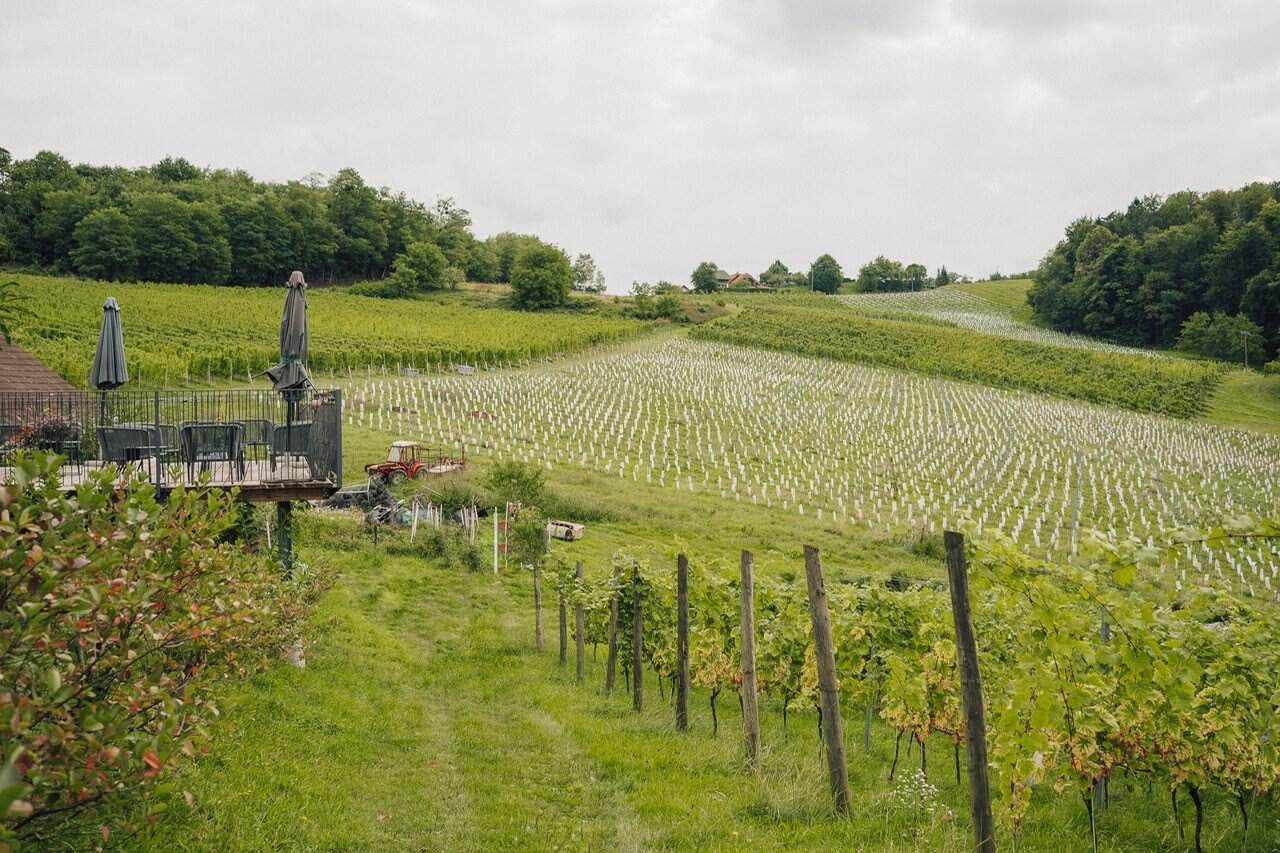
Image: Hisa Joannes Protner’s organic vineyards in northern Slovenia. You can try their Ranfol here.
Ranfol is best known as a blending grape, bringing freshness, balance, and drinkability to Slovenian white wines. Yet its role extends far beyond simple utility.
As a native grape variety, Ranfol thrives in the climate and soils where growers have cultivated it for generations. Because it truly belongs there, it demands fewer interventions in the vineyard than many international varieties.
In practice, growers can farm Ranfol more sustainably, relying on lower chemical inputs and embracing organic or low-intervention methods with greater confidence. At a time of mounting climate pressure and rising production costs, that resilience becomes a genuine advantage not a footnote.
Ranfol is rarely bottled on its own though it plays an important role in Slovenian wine, particularly in Štajerska Slovenija. This guide explains what the Ranfol grape is, how Ranfol wine tastes, where it grows, and why it remains relevant in modern Slovenian winemaking.
What is the Ranfol grape?
Ranfol is a native Slovenian white grape that grows naturally in cooler, continental regions. It produces wines with moderate alcohol, gentle acidity, and a restrained aromatic profile, favouring clarity and balance over overt intensity.
These qualities have historically made Ranfol ideal for blending, where it can soften more assertive varieties and enhance freshness. However, blending is only part of the story.
What does the wine taste like?
In general: light, crisp, and refreshing, with flavours of green apple, pear, citrus peel, and subtle herbal notes. When carefully managed, Ranfol can be elevated far beyond its everyday reputation.
Given lower yields, longer lees contact, and precise winemaking, It can even develop a profile reminiscent of dry Riesling, showing:
- Bright citrus and lime
- A firm, linear structure
- Flinty or mineral notes
- Occasional petrol-like aromas with age
In these expressions, Ranfol is no longer just a background component, but a wine of clarity, tension, and surprising depth.
Slovenian winemaking legend, Boštjan Protner has taken on the challenge of turning Ranfol into a single varietal wine. Guided by his organic, natural wine philosophy Protner draws inspiration from cheeky local spirit, Bolfenk the Dwarf. Bolfenk watches over vineyards with the power to spoil mistreated wines. He rewards care and respect for the land whilst punishing greed and laziness.
See for yourself how Slovenia’s ‘King of Riesling’ has transformed this quiet local legend.
Why Ranfol matters
Ranfol may not carry the prestige of Slovenia’s headline varieties, but it remains foundational. It offers environmental suitability, versatility, and (in the right hands) genuine quality.
For drinkers interested in sustainable viticulture and understated, site-driven wines, it shows how a native grape can quietly bridge tradition, ecology, and modern ambition.
Explore More Grape Guides
- Teran: The grape Europe fought over
 Nobody fights over grapes that do not matter.
 - Vrachanski Misket: The Dictator’s Favourite Grape That Refused to Disappear
 Vrachanski Misket is not an easy name to remember. Which makes its survival even more impressive.
 - Rubin: The Bulgarian Grape That Waited for the World to Catch Up
 Most grapes evolve over centuries. Rubin was designed for the future.
 - Vrachanski Misket: Bulgaria’s aromatic original
 Vrachanski Misket is one of Bulgaria’s most distinctive native white grapes.
 - How Gouveio brings balance to Alentejo white wine
 Image: the vineyards of Quinta da Plansel in Alentejo, Portugal. You can try their wines here. Once closely associated with… Read more: How Gouveio brings balance to Alentejo white wine
 - Ranfol: The Slovenian wine grape you’re meant to overlook
 Image: Hisa Joannes Protner’s organic vineyards in northern Slovenia. You can try their Ranfol here. Ranfol is best known as… Read more: Ranfol: The Slovenian wine grape you’re meant to overlook
 - Tinta Barroca: Portugal’s unsung blending grape
 Valued for its colour, richness, and approachability, Tinta Barroca has traditionally been used as a blending grape, both in Port… Read more: Tinta Barroca: Portugal’s unsung blending grape
 - Discover Touriga Nacional: Portugal’s celebrated red wine grape
 Touriga Nacional is Portugal’s most celebrated native red grape — aromatic, structured, and capable of producing some of the country’s… Read more: Discover Touriga Nacional: Portugal’s celebrated red wine grape
 - Rebula: The ancient grape perfectly suited to a warming world
 Image: Rebula grapes at Ferdinand’s vineyards in Brda, Slovenia. You can try Matjaž’s Rebula here. In a wine world increasingly… Read more: Rebula: The ancient grape perfectly suited to a warming world